User Experience – 15,000 Nautical Miles
We bought the Remoran Wave 3 for our Atlantic circumnavigation, mainly to give us a reliable source of electricity on the longer offshore legs.
Our power consumption at sea averages around 60–200 Ah per day, depending on whether we are making fresh water with the watermaker and how much time we spend online using Starlink. Our everyday consumption comes from the usual essentials: navigation electronics, refrigeration, lights, and charging phones, tablets and other devices. On colder passages, the heater also requires its share of the available power.
We have a 400 Ah LiFePO4 house battery bank, and after around 15,000 nautical miles, we have a pretty good idea of how Remoran performs in real-world conditions.
Simple by design
Remoran is a wonderfully minimalist piece of equipment. It is quick to install and just as easy to remove when we are at anchor or in port. Once the generator unit is lifted out, all that remains on the transom is a neat 200 mm aluminium rail. When the unit is not in use, it is simply out of the way.
Installation was straightforward. Our transom is slightly convex, so we added a 6 mm fabric-reinforced, shaped rubber mat between the rail and the hull to spread the pressure evenly.
The supplied deck connector was also easy to fit. The electrical installation was about as simple as it gets: one cable from the generator to the charge controller and another from the controller to the batteries. We treated the deck connector with battery grease, and we did not experience a single problem with it during the year.
There was one small issue during the first 1,000 miles. Several of the visible screws in the angle adjustment and mounting structure had worked themselves loose. We added thread locker, tightened everything up, and that was the end of the problem.
Putting the Wave 3 to the test
Our first test was in early April. Neither the air nor seawater temperatures, which were around freezing, seemed to have any effect on the unit's performance. In a fresh breeze, we had more than enough speed and power generation. With the help of the solar panels, the batteries were fully charged within a couple of hours.
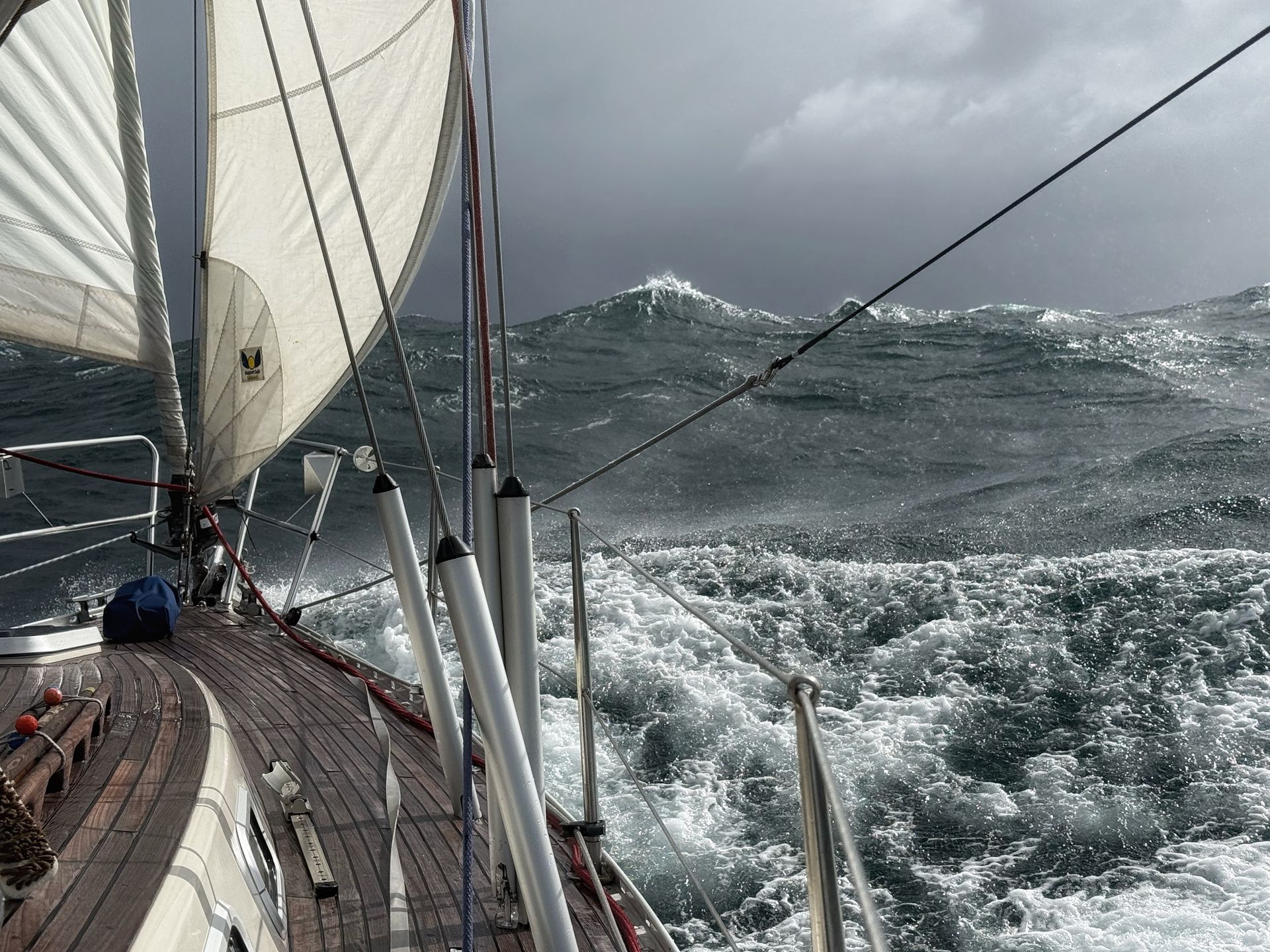
Once boat speed drops below around four knots, the output naturally starts to fall. At the same time, the drag from the hydrogenerator becomes more noticeable relative to the boat's speed. In the archipelago, where shore power is often available anyway, we chose to prioritise boat speed over power generation in light winds.
When the wind picked up, however, hydrogenerator became a valuable addition to our energy system, particularly on cloudy days and later in the season when daylight hours were getting shorter. For sailors spending long periods on the water, this is where we found the hydrogenerator particularly useful.
On long offshore passages, we found the hydrogenerator to be a highly practical and consistent way of producing electricity. If I had to choose between a hydrogenerator and solar panels alone, I would choose the hydrogenerator. That said, having several independent ways of producing energy gives you valuable redundancy — and that matters offshore.
Plenty of power offshore
During our year-long journey, we averaged around 5.5–6 knots, and Remoran produced enough electricity to keep up with our needs even with Starlink running continuously.
The solar panels provided the extra capacity needed to run the water maker, and on our longer offshore passages we generally sailed with the batteries close to full. The state of charge was above 80% most of the time.
The Sargassum challenge
The only real problems we encountered came during our westbound Atlantic crossing.

The enormous Sargassum mats were a completely different challenge. At one point, a huge mass of seaweed built up around the unit — at its worst, roughly half a metre thick — and the vibration was strong enough to shake the whole boat.
The only way to clear it was to climb onto the bathing platform and pull the seaweed away by hand.
On one occasion, a nylon rope had also become tangled around the propeller among the seaweed. With a standard installation, the unit is not designed to be lifted while the boat is underway, and we wouldn’t recommend trying it. However, after surfing, when we had managed to slow the boat to below four knots, we could tilt the unit and slide it off the rail for cleaning.
At higher speeds, the angle adjustment lock simply wouldn’t budge. We tried everything we had on board but nothing was enough to release it. The same proved true when we tried to reinstall the unit. After a full day of repeatedly clearing seaweed, the risks of attempting it at speed were becoming all too obvious. In the end, we decided it was better to remove the unit than risk damaging something — or ourselves.
Once the hydrogenerator was out of service, the impact on our power supply was immediately noticeable. We ended up running the diesel engine for a couple of hours to recharge the batteries, allowing us to arrive in Tobago with full water tanks and a reasonable state of charge.
The Sargassum also damaged the angle adjustment mechanism. The plastic gear pieces are designed to act as sacrificial parts in the event of an impact, and a couple of the teeth were slightly bent. Despite that, they survived another 6,000+ nautical miles and are still in use today. Having spare angle-adjustment gear pieces in the spare parts kit would, in our experience, be a worthwhile addition.
Built for life at sea
Remoran has been an incredibly durable and trouble-free piece of equipment. At times, the propeller has been spinning in the air. At others, the unit has taken breaking waves of more than five metres from behind. Through all these conditions, the unit continued to perform reliably, from near-freezing 0°C waters to tropical 28°C — with no temperature-related issues.
We broke our boat's speed record several times during the trip, and even 15-knot surfs caused no problems, despite the fact that we had not fitted the protective relay. Of course, our actual speed through the water was considerably lower in those conditions and rarely exceeded 10 knots.
After 15,000 nautical miles, the main thing we found ourselves wishing for was a simple and safe way to raise and lower the unit while sailing. This would have been especially useful when passing through areas with heavy Sargassum.
We did not originally purchase the Easy Lift system because installing it on our small, curved transom would have been challenging. Looking back, though, the experience at sea showed us that it would have been a very useful addition.
Jussi and Helena Santala
You can read more about our journey and see more photos on our blog:
Check out the accessories recommend for Atlantic crossings in our web shop:
Crossing the Atlantic with Remoran Wave 3GS